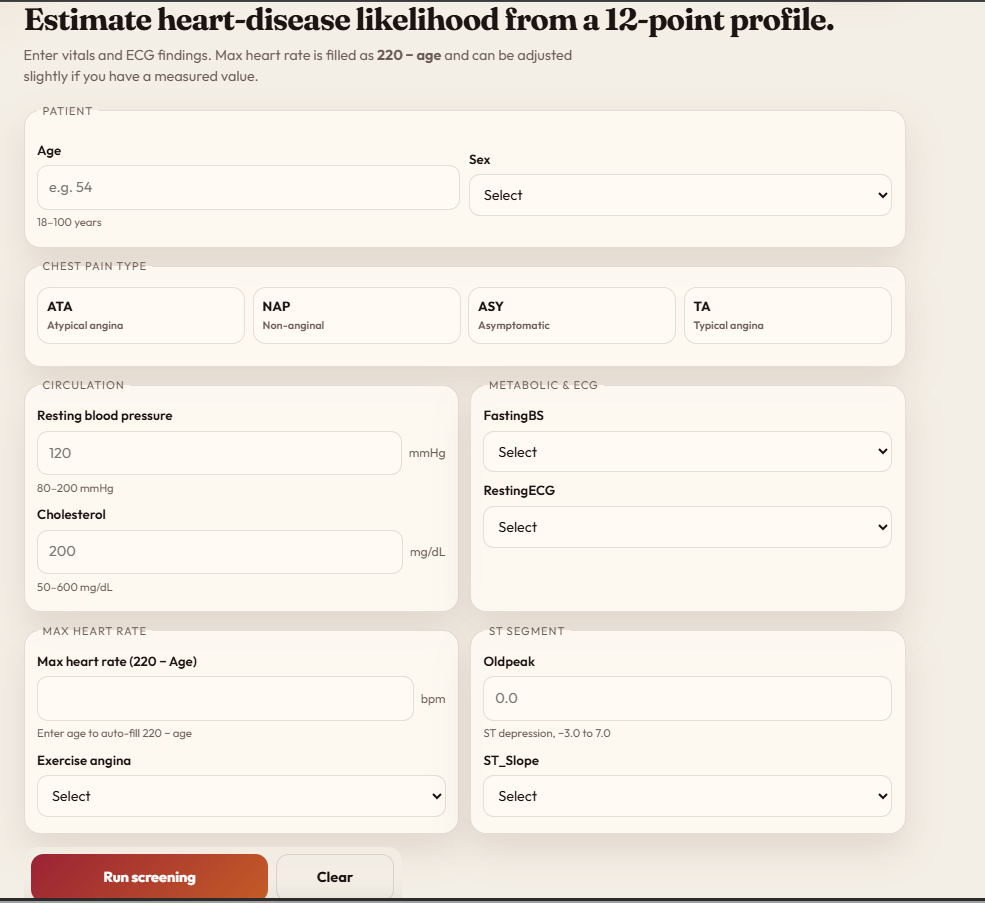
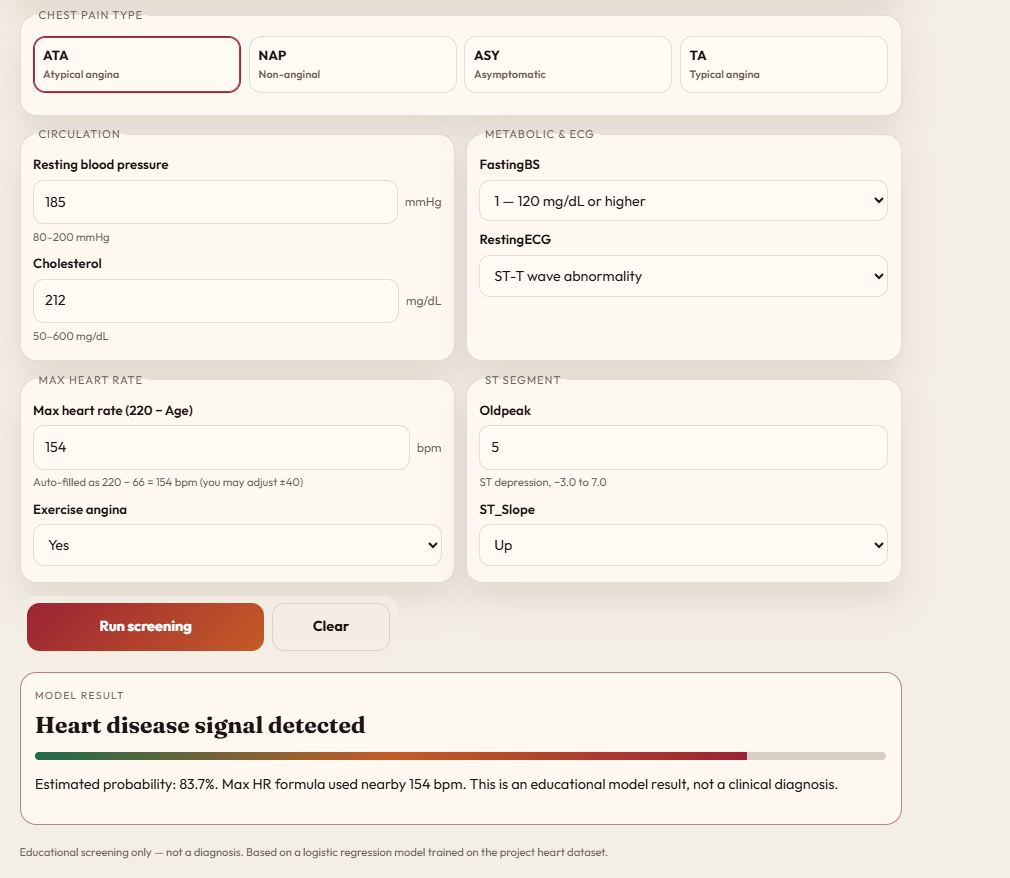
- High Accuracy ML Model: Developed a machine learning application to predict heart disease risk using clinical data, achieving over 87% accuracy.
- Interactive User Interface: Built an interactive user interface for instant preliminary risk predictions using real-world Kaggle datasets.
- End-to-End Cloud Deployment: Deployed the application on Vercel, gaining hands-on experience in end-to-end AI product development.
- Live Application: hearthealthchecker.vercel.app ↗
1. The Problem
Cardiovascular diseases represent one of the leading causes of mortality globally, yet early symptoms and multi-factor clinical indicators are frequently overlooked until acute complications arise. Evaluating patient risk often involves analyzing intricate combinations of clinical variables — such as resting blood pressure, serum cholesterol levels, fasting blood sugar, chest pain type, resting ECG findings, and maximum heart rate achieved.
For non-specialists and early screening contexts, synthesizing these interdependent biometric indicators quickly and reliably is challenging. The goal was to explore whether machine learning could provide an instant, accessible preliminary risk assessment based on verified clinical parameters.
2. Why It Mattered
Early risk screening can empower individuals to seek timely medical consultations before cardiovascular conditions escalate. By taking real-world medical datasets and building a complete web tool around them, this project explored how artificial intelligence can make preventive health indicators more interpretable and actionable.
It also offered a direct learning ground in end-to-end product development: addressing data cleaning, managing class balance, evaluating trade-offs between precision and recall, and deploying a responsive, accessible interface on the web.
3. What I Built
I engineered an interactive machine learning web application that predicts cardiovascular risk likelihood based on patient clinical input:
- Dataset Preprocessing & EDA: Conducted exploratory data analysis on clinical cardiovascular data from Kaggle, handling feature scaling, encoding categorical variables, and addressing correlations among biometric attributes.
- Model Development & Tuning: Experimented with multiple classification algorithms to determine optimal performance, achieving over 87% accuracy with strong generalization across test splits.
- Interactive Web Interface: Created an intuitive, user-friendly frontend enabling individuals to input clinical parameters and receive real-time predictive risk feedback.
- Production Deployment on Vercel: Configured a streamlined, cloud-hosted architecture on Vercel, ensuring fast response times and global accessibility — live at hearthealthchecker.vercel.app ↗.
- Clinical Dataset Analysis: Trained and validated on comprehensive Kaggle cardiovascular records containing multiple diagnostic biomarkers.
- Classification Pipeline: Preprocessing pipelines featuring standard scaling, robust categorical encoding, and optimized hyperparameter tuning.
- Instant Prediction Engine: Lightweight model inference returning preliminary risk categorizations with parameter sensitivity indicators.
- Cloud Deployment: Hosted continuously on Vercel with responsive styling for desktop and mobile devices.
4. What Went Wrong & What I Learned
In healthcare machine learning, raw accuracy is not the sole metric that matters. Early model iterations showed decent accuracy but suffered from false negatives — a dangerous pitfall when predicting medical risk. I had to tune decision thresholds and analyze the confusion matrix to ensure high sensitivity (recall) was prioritized so high-risk profiles were reliably flagged.
Additionally, translating machine learning predictions to non-technical users taught me the necessity of clear, ethical UI design: emphasizing that predictive tools are designed for educational and preliminary screening awareness, never as a replacement for formal professional medical diagnosis.